




UMass Boston Researcher Receives Grant to Study Cyberattacks on Power Grids


Ioannis Zografopoulos, an assistant professor in the Engineering Department of the College of Science and Mathematics at UMass Boston, has been awarded a grant from the National Science Foundation (NSF) to study the cybersecurity of power grids targeted by communications-based cyberattacks.
In a communications-based cyberattack, malicious actors can spread through a network of different infected devices as the devices communicate with each other. Modern power grids can be vulnerable to this kind of attack, due to their complexity, remote access, and their ability to rapidly react to consumer energy needs. In his research at UMass Boston, Zografopoulos studies how cyberattacks can spread through a network of connected devices—and how they can be stopped.
“Grids of the past were passive,” says Zografopoulos. “Every item was just consuming power; it wasn’t generating.” These days, he says, power grids have to react to power flowing back into the grid, often from renewable sources.
“Today we have rooftop solar panels and solar farms, electric vehicles which can both charge and discharge, large-scale battery storage, and even micro nuclear reactors which can operate on either the distribution side or the transmission side. The power grid has become a far more intricate system, and in order to coordinate it and keep it balanced, we need constant communication and a seamless exchange of information.”
Threat actors can hijack communications between devices in a power grid, exploiting their connectivity. In a modern interconnected system, an effective cyberattack could have cascading effects on power distribution and transmission. A single devastating cyberattack could cripple device after device, cascading through vast sections of the power grid. In 2015 and 2016, hackers did exactly that in Ukraine, using malware to plunge entire cities into darkness.
With the support of his new NSF grant, Zografopoulos will be developing and testing several different ways to protect networks. For instance, by adopting secure communications techniques, such as encryption and data verification, power distributors can strengthen vulnerable parts of the network and give them an added layer of protection. UMass Boston students will have a chance to contribute to this research: the grant includes funding to support at least one graduate student, as well as undergraduate students.
Zografopoulos will also experiment with “network islanding,” a practice of locking down portions of a communications network to isolate areas that have been compromised. Communications could then be routed around the affected areas using redundant pathways and network reconfiguration. Like quarantining an infection, islanding could allow communication networks to keep functioning, even while a cyberattack is underway.
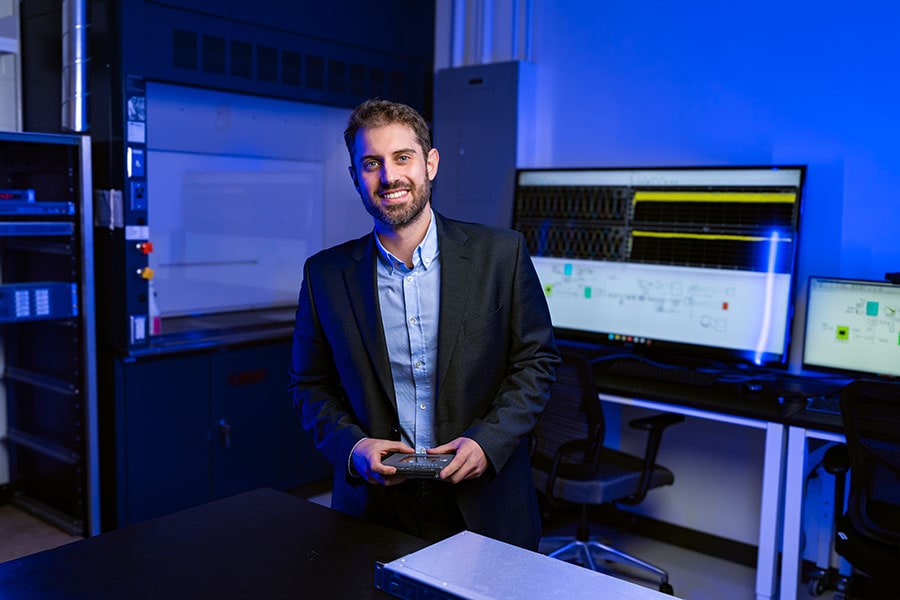
The experiments will take place in Zografopoulos’ Infrastructure Cybersecurity and Resilience Laboratory (ICARUS), in the ICARUS testbed they have constructed. The testbed mimics an entire power grid in a virtual format, running the same software in the same configurations as an actual power grid—but without any actual power exchange through generation or consumption.
“Everything that is happening in our real-time testbed is exactly the same as if it were being tested in Eversource, or National Grid, or any of those distribution or transmission system operators,” Zografopoulos says. This enables his team to safely observe, in real time, what happens when the virtual equipment is hit with a cyberattack.
This unique testbed setup was recently expanded with a donation of equipment from SEL (Schweitzer Engineering Laboratories). The testbed now includes a satellite-synchronized clock to ensure that different power system components are perfectly in sync, automation controllers designed to control distribution systems, and an Ethernet security gateway and switch designed to protect communication networks from cyberattacks.
By connecting this equipment to ICARUS, Zografopoulos has been able to create a “microgrid,” a miniature version of the power network that offers a clearer view of how cyberattacks could disrupt energy distribution. It also makes the ICARUS lab a unique environment to design safer, more resilient protections for tomorrow’s power grids.
Latest University News
- At the Boston Globe Summit, UMass Boston Faculty, Staff and Students Tell Stories of Making an ImpactLuminaries from art, science, business and politics gathered to give lectures and discussions on this year’s most important issues. UMass Boston was a proud sponsor of this year’s Boston Globe Summit.
- UMass Boston’s College of Management Celebrates 50 YearsThe UMass Boston College of Management marked a defining milestone as faculty, staff, students, alumni, and university leaders gathered to celebrate the college’s 50th anniversary - five decades of expanding access to high-quality business education.
- UMass Boston’s Sixth Annual Black Lives Matter Day Honors Black Cultural Resilience in Challenging TimesAt a moment when Black culture is being legislated against, sanitized, and distorted in public memory, UMass Boston gathered on November 3 for something far more potent than a university event. The sixth annual Black Lives Matter Day was a reminder that Black culture is not a side note in American life, but a backbone and creative engine that has carried generations through both devastation and possibility.
- UMass Boston Marketing Professor Named One of the World’s Most Influential ResearchersProfessor Werner Kunz of the College of Management has been named a Highly Cited Researcher 2025 by Clarivate, recognizing him as one of the world’s most influential researchers.
- Student-Athlete Nathan Rubin Debuts Children’s Book "Chasing a Dream"UMass Boston basketball player and economics major Nathan Rubin has published a children’s book to inspire kids to dream big and work toward achieving their goals.
- Recipients of Chancellor’s Distinguished Faculty Award Gather for Annual LecturesOn November 13, three faculty members were recognized for their contributions to scholarship, teaching, and service. This year marks the 15th Chancellor’s Distinguished Faculty Award Lectures, which celebrates these faculty members’ exceptional contributions to their fields and to the UMass Boston community.