




Biology Team to Survey Reptiles and Amphibians in National Parks with $190K NPS Cooperative Agreement


Professors of Biology Rob Stevenson and Doug Woodhams, from the College of Science and Mathematics, have received a two-year award for $190,000 from the Department of the Interior’s National Park Service to develop a comprehensive survey of reptiles and amphibians in participating parks.
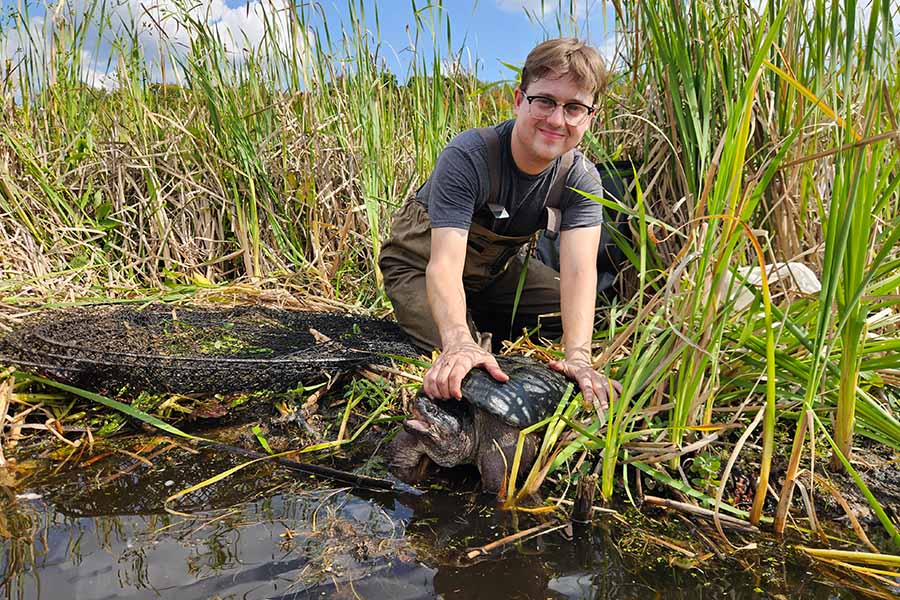
The field sampling is being led by graduate student Alexander Richards and co-advised by Stevenson and Woodhams. With the grant funds, the team will document the presence, absence, and relative abundance of various species to compare these findings with herpetological surveys from 2001 and assess the health of these animal populations and their habitats.
The project includes a disease ecology component, targeting emerging threats such as snake fungal disease and chytrid fungus in amphibians. Field and lab teams will collect and analyze samples to generate early-warning data that can guide rapid response and habitat management.
The research “combines a suite of traditional sampling methods such as cover boards, walking surveys, and baited traps, with innovative technologies, such as environmental DNA analysis and automated audio monitoring, which improve the detection of elusive species,” said Richards.
Field teams of undergraduate students and recent biology graduates will work alongside participating park partners to collect and analyze the data. Park partners include Minute Man National Historical Park and Saugus Iron Works National Historic Site in Massachusetts, and Morristown National Historical Park in New Jersey.
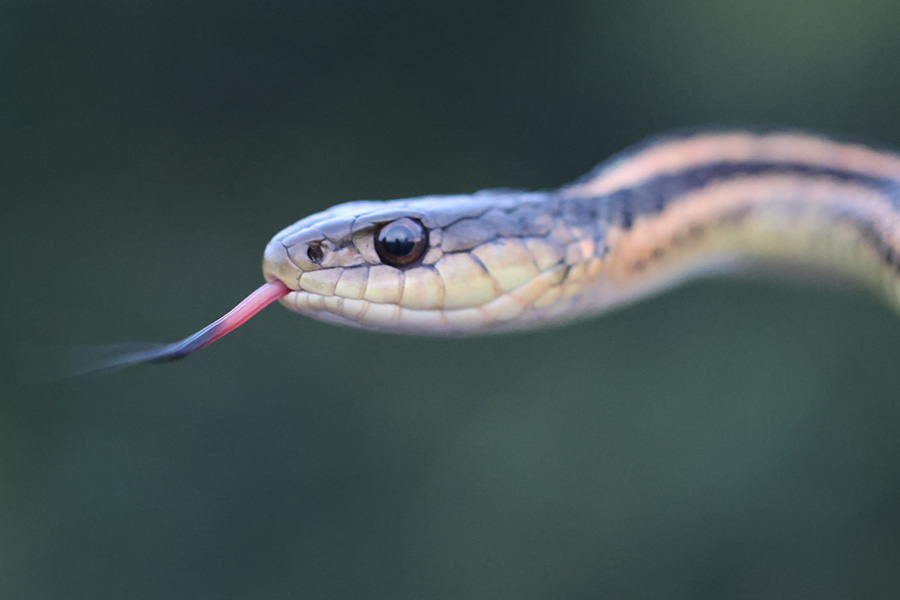
Photo by Alexander Richards
A common garter snake (Thamnophis sirtalis), likely the most abundant snake species across all three parks.
Part of what makes this research so important is the collaboration. “This effort takes place through a formal cooperative agreement between the National Park Service and UMass Boston, supporting the exchange of knowledge, collaborative resource use, and expanded professional networking within the conservation and research community,” said Richards.
Findings from the data will feed directly into species status assessments and management objectives for participating parks, while informing conservation, management, and educational outreach at the local and regional levels. By combining field observations with modern detection technologies and disease screening, the UMass Boston team aims to target ongoing threats from wildlife diseases and environmental changes.
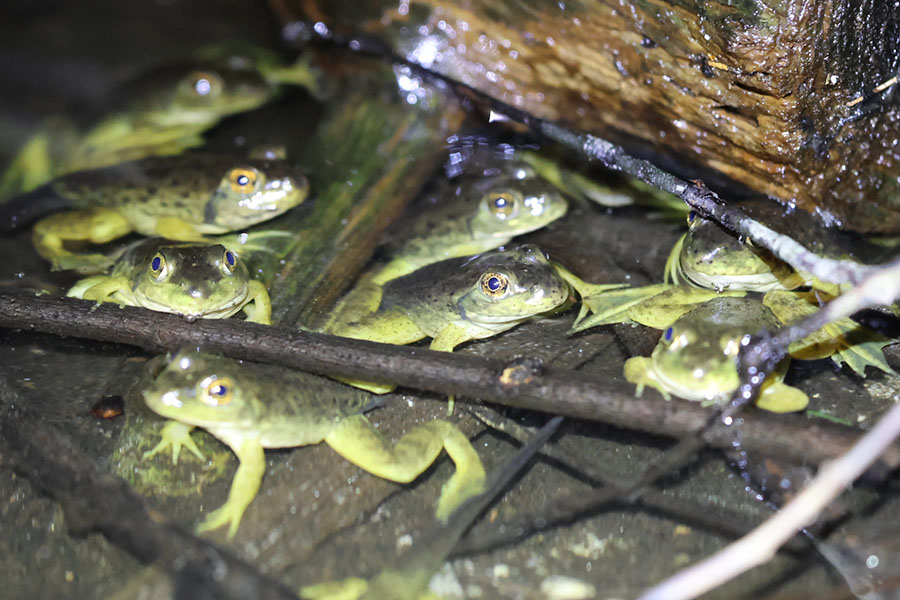
Photo by Alexander Richards
A section of a pond in Minute Man National Historical Park filled with bullfrog (Lithobates catesbeianus) metamorphs. After spending one to three years as tadpoles in the larval stage, they have finally started transforming into frogs.
The funding from NPS will be used to purchase field and sampling equipment, support logistics and transportation, laboratory analyses tied to disease screening, and training for students and recent graduates.
“The project provides hands-on training for students in field herpetology, wildlife disease ecology, and population monitoring,” said Richards. “Time commitment is flexible to accommodate academic schedules, supporting broad student participation.”
Interested volunteers should email A.Richards001@umb.edu.
Latest University News
- At the Boston Globe Summit, UMass Boston Faculty, Staff and Students Tell Stories of Making an ImpactLuminaries from art, science, business and politics gathered to give lectures and discussions on this year’s most important issues. UMass Boston was a proud sponsor of this year’s Boston Globe Summit.
- UMass Boston’s College of Management Celebrates 50 YearsThe UMass Boston College of Management marked a defining milestone as faculty, staff, students, alumni, and university leaders gathered to celebrate the college’s 50th anniversary - five decades of expanding access to high-quality business education.
- UMass Boston’s Sixth Annual Black Lives Matter Day Honors Black Cultural Resilience in Challenging TimesAt a moment when Black culture is being legislated against, sanitized, and distorted in public memory, UMass Boston gathered on November 3 for something far more potent than a university event. The sixth annual Black Lives Matter Day was a reminder that Black culture is not a side note in American life, but a backbone and creative engine that has carried generations through both devastation and possibility.
- UMass Boston Marketing Professor Named One of the World’s Most Influential ResearchersProfessor Werner Kunz of the College of Management has been named a Highly Cited Researcher 2025 by Clarivate, recognizing him as one of the world’s most influential researchers.
- Student-Athlete Nathan Rubin Debuts Children’s Book "Chasing a Dream"UMass Boston basketball player and economics major Nathan Rubin has published a children’s book to inspire kids to dream big and work toward achieving their goals.
- UMass Boston Researcher Receives Grant to Study Cyberattacks on Power GridsIoannis Zografopoulos, an assistant professor in the Engineering Department of the College of Science and Mathematics at UMass Boston, has been awarded a grant from the National Science Foundation (NSF) to study the cybersecurity of power grids targeted by communications-based cyberattacks.